On January 3, 2026, the United States launched a military strike on Venezuela and captured President Nicolás Maduro and his wife, indicting them on several charges related to narcoterrorism
Cyabra’s analysis of online conversations related to this operation uncovered a battle of influence: sophisticated influence operation surrounding the U.S. military operation in Venezuela and the reported capture of President Nicolás Maduro. The investigation revealed how bad actors deployed coordinated networks as they battled over narrative control, dramatically reversing public perception from pro-U.S. to anti-U.S. in just one single day.
TL;DR
- The first coordinated network launched just before the operation: a sophisticated pro-U.S. campaign, which appeared organic and supported the military operation
- Within just 6 hours, a bigger, less advanced fake campaign managed to completely reverse the narrative by pushing anti-U.S. messaging
- Overall, 4,036 fake profiles (23% of the profiles in the discourse) gained 641M+ potential views and 329,101+ engagements, showing a huge impact on public opinion
- The fake campaigns weaponized hashtags such as #VenezuelaLibre and #AmericaLatinaLibre to maximize their reach, dominating 69% of hashtag usage.
The Anatomy of a Coordinated Influence Operation
What made the influence operation around the U.S. military action in Venezuela so significant was not merely its scale, but the precision of its execution – starting weeks before the operation was launched, and shifting public opinion in real-time before, after and during the operation.
Cyabra’s analysis found that 23% of the profiles engaged in the U.S.-Venezuela discourse were fake, more than three times the baseline of inauthentic accounts online. These 4,036 fake profiles generated 4,878 posts and comments, achieving a potential reach of over 641 million views, and more than 329,101 engagements.
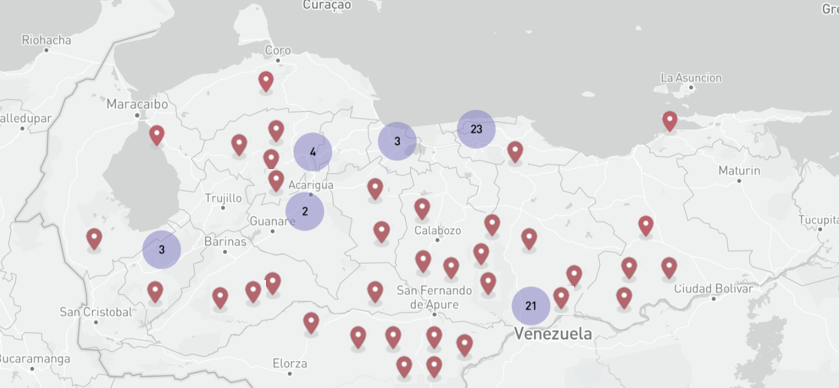
On January 3 alone, coordinated fake profiles gained 223,864 engagements in a single day. Network analysis revealed a particularly active cluster of just 66 fake profiles, located in Venezuela, that garnered 190,000 potential views through 112 posts and comments, laying the groundwork for the broader narrative shift.
The Bot Battle: From Preparation to Reversal
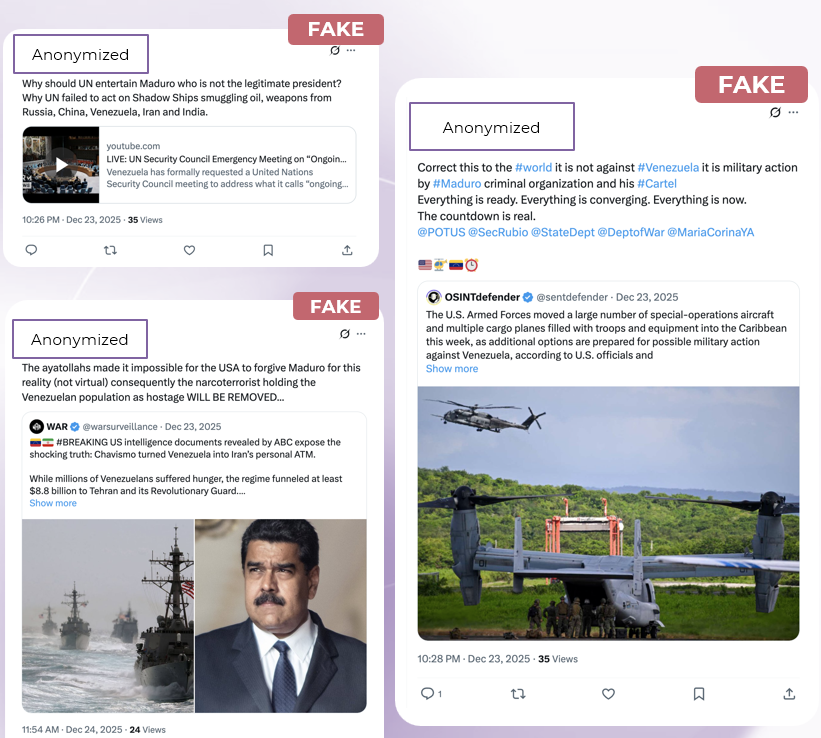
Pre-Operation (December 22-24, 2025):
A network of 485 fake profiles generated 554 posts and comments, designed to prepare public opinion for U.S. military intervention. These profiles strategically amplified narratives portraying Maduro as a criminal ruler involved in drug trafficking, deliberately echoing rhetoric from Donald Trump.
These profiles operated with subtle coordination based on similar content with varied phrasing, overlapping posting times, and no visible network connections. This approach gave the campaign an organic appearance while framing military action as the only viable response to what they characterized as Maduro’s “narco-regime.”
Operation Day (January 3, 2026):
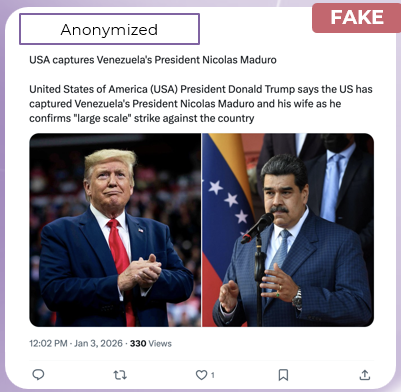
The operation goes next level: Fake profiles flooded social media with uniform, military-style messaging, establishing a single interpretation: a successful, justified U.S. military operation. Coordination became more visible through posts published within minutes of each other, identical terminology across hundreds of profiles, and consistent military framing using terms like “large-scale strike” and “capture.” Attempting to look informative and objective, those profiles portrayed the United States as the prevailing actor.
The Six-Hour Narrative Reversal:
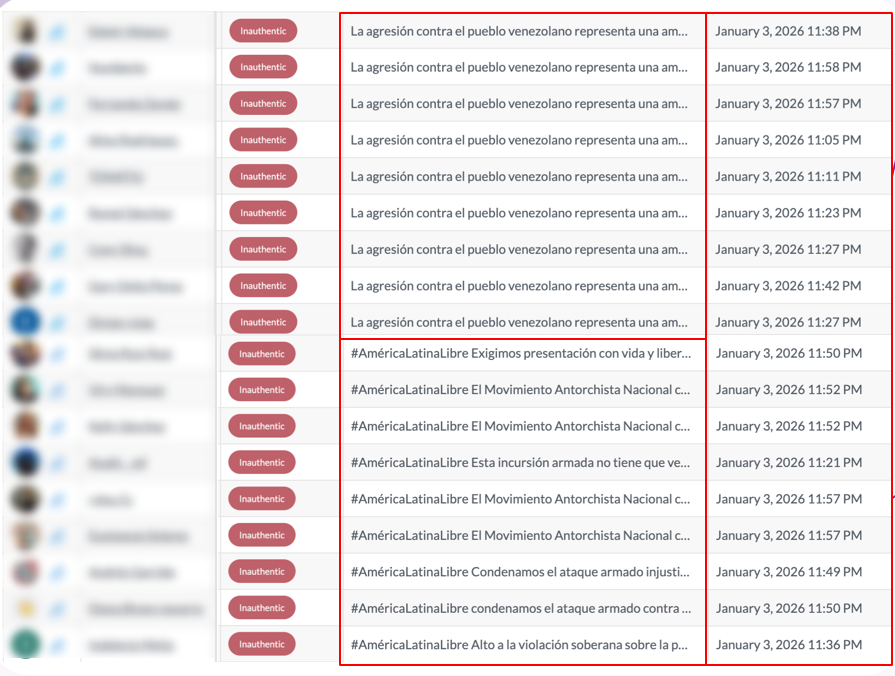
Within just six hours after the military operation started, Cyabra identified a complete narrative reversal that transformed public discourse from pro-U.S. to anti-U.S. Large groups of profiles worked in parallel to reinforce emotionally charged and accusatory messaging, creating the appearance of widespread public outrage and international consensus. This shift reframed the operation as an “illegal kidnapping,” portrayed the U.S. as an aggressor, and repositioned Maduro as a legitimate leader and victim.
Hashtag Weaponization
Central to the post-operation narrative reversal was the strategic weaponization of specific hashtags by the anti-U.S. campaign. Cyabra’s analysis found that these hashtags served as key amplification hubs:
- #VenezuelaLibre: Approximately 30% of profiles using this hashtag were identified as fake
- #AmericaLatinaLibre: Up to 69% of profiles using this hashtag were identified as inauthentic
These hashtags served as coordination mechanisms, supporting the illusion of widespread public consensus, establishing emotional framing around Venezuela’s sovereignty, and attracting genuine engagement.
Pre vs. Post: Different Coordination Playbooks
Cyabra’s investigation identified distinctly different tactics between phases, revealing a trade-off between sophistication and speed:
Pre-Operation (More Sophisticated): Limited visible connections between profiles, subtle message variations while maintaining core themes, and organic-appearing posting times. This highly sophisticated coordination model was designed to fly under the radar and appear authentic.
Post-Operation (Less Sophisticated, Higher Volume): Clear network connections, identical content across clusters, heavy reliance on emotional hashtags like #VenezuelaLibre (69% fake profiles) and #AmericaLatinaLibre (30% fake profiles), concentrated posting during specific time windows, abnormally low engagement rates despite high reach, and geographic clustering (such as the 66 profiles all located in Venezuela). The dense network activity was designed to create the impression of widespread outrage through speed and volume rather than stealth.
The New Battlefield of Narrative Control
For government agencies, the most concerning aspect of the Venezuela case study should be the speed of narrative transformation and the success of the influence operations campaigns. Within just six hours, coordinated networks completely reversed public perception from viewing a U.S. military operation as justified to framing it as illegal and imperialistic. This capability to swiftly and rapidly reshape public opinion poses a significant threat to government operations that rely on public support.
For intelligence agencies, election integrity commissions, and government communications departments, understanding coordination patterns, timing strategies, and narrative manipulation techniques is essential to protecting the information environment during critical national security operations.
Learn More
For government agencies, this case highlights critical warning signs:
* Abnormal content volume spikes around significant events
* Uniform messaging across large numbers of profiles
* Hashtag clusters with high percentages of inauthentic profiles
* Rapid narrative reversals within narrow timeframes
* Coordinated posting patterns across seemingly unconnected accounts
* Real-time monitoring systems focused on coordination patterns
* Hashtag analysis protocols to identify unusual levels of inauthentic activity
* Network visualization tools revealing hidden connections between accounts
* Rapid response capabilities addressing narrative shifts within hours, not days
* Pre-positioned verified information to counter anticipated narrative reversals
Hashtags serve as amplification engines on social media platforms. By dominating trending hashtags, coordinated networks can: reach users beyond their immediate followers, create the illusion of widespread public consensus, attract authentic users who engage with trending topics, establish emotional framing around events, and ensure their narratives appear in search results and platform recommendations. Hashtags transform localized coordination into platform-wide visibility.
Modern influence operations can reverse public narratives within hours, not days. By the time traditional fact-checking or response mechanisms activate, the manipulated narrative may already dominate public discourse and shape policy decisions. Real-time monitoring and rapid response capabilities (within hours) are essential because once a narrative becomes entrenched, correcting it requires significantly more effort and may never fully succeed.