


Cyabra CPO Yossef Daar draws on nearly 12 years of experience on both sides of influence operations to explain how small networks of inauthentic accounts can manufacture consensus that moves markets and destroys reputations. The piece walks through the mechanics, the psychology, and what corporate leaders need to do about it.
- A network of 50 to 100 inauthentic accounts can trigger algorithmic amplification that reaches millions of real users and moves stock prices
- Real people sharing a fabricated narrative give it legitimacy that no fact-check can fully reverse
- The cost of launching sophisticated influence operations has collapsed, making every publicly traded company a potential target
- Companies need detection systems, rapid response capabilities, and authentic community-building to defend their narrative space
After nearly twelve years working with coordinated inauthentic campaigns, I’ve witnessed a troubling evolution: a handful of fake accounts can now manufacture consensus that moves markets, destroys reputations, and rewrites truth.
I spent three and a half years on the offensive side of this battlefield, orchestrating social media campaigns designed to shape narratives. For the past eight years at Cyabra, I’ve worked on defense, detecting and analyzing the disinformation campaigns and fabricated narratives that flood social networks and news ecosystems. The transition from perpetrator to protector has given me a unique vantage point: I’ve seen both how easy it is to manipulate reality and how devastating the consequences can be.
The uncomfortable truth that senior executives need to understand is this: Your company’s stock price, your brand’s reputation, and your customers’ perception of reality can be hijacked by coordinated networks of fake accounts that cost less to operate than a single employee’s salary.
The Mechanics of Manufactured Consensus
The sophistication of today’s inauthentic campaigns has evolved far beyond crude bot farms. Modern influence operations combine AI-generated profile pictures, deepfake videos, synthetic text, and coordinated timing to create what appears to be organic grassroots movements. These aren’t teenagers in basements. They’re well-funded operations with clear strategic objectives.
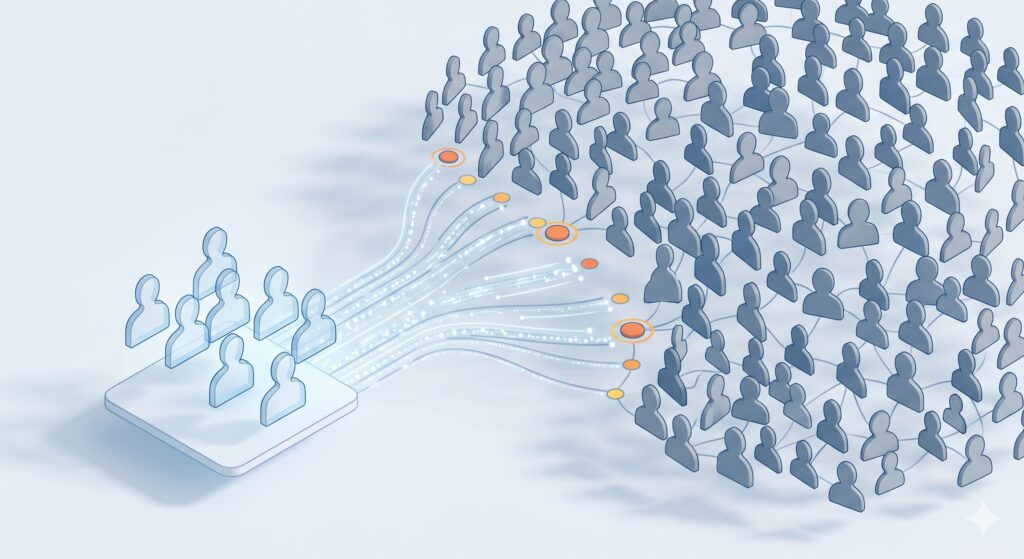
Consider what we now know about coordinated campaigns targeting publicly traded companies. A network of 50 to 100 carefully crafted fake accounts, posting at strategic intervals, can trigger algorithmic amplification that reaches millions of real users. Once real people begin engaging with and sharing the fabricated narrative, the distinction between synthetic and authentic content disappears entirely.
The pattern repeats across industries. A pharmaceutical company faces a sudden wave of patient testimonials about side effects that don’t exist in clinical data. A tech firm’s product launch is derailed by coordinated user complaints from accounts that never purchased the product. A financial services company watches its stock tumble as fabricated insider information spreads across Twitter and Reddit.
The Herd Effect: When Fake Becomes Real
The most dangerous aspect of these campaigns isn’t the fake content itself. It’s what happens when real people encounter it.
Humans are social creatures with a powerful instinct to align with perceived consensus. When we see hundreds of accounts expressing the same concern, sharing the same outrage, or promoting the same narrative, our brains interpret this as social proof. This cognitive bias has been documented extensively in behavioral economics, but it takes on new significance in an era of synthetic social media.
This is where synthetic campaigns become genuinely dangerous. The fake accounts don’t need to convince everyone. They just need to convince enough real people to create a self-sustaining chain reaction. Once authentic users begin repeating and amplifying a fabricated narrative, it achieves legitimacy that no fact-check can fully reverse.
I’ve watched this dynamic play out dozens of times. A coordinated network plants a seed: unfounded safety concerns about a product, unverified claims about executive misconduct, fabricated regulatory troubles. Within hours, algorithmic amplification begins. Within days, genuine consumers are sharing the concerns with their networks, journalists are writing “some users report” stories, and investors are reassessing their positions. The original fake accounts may have numbered in the dozens, but the impact cascades across millions.

The Stock Price Connection
For publicly traded companies, these dynamics have direct financial consequences. Markets move on perception as much as reality, and perception is now easily manipulated at scale.
In 2023, we observed several cases where coordinated inauthentic campaigns preceded significant stock movements. The playbook is consistent: Build or activate a network of synthetic accounts. Introduce a negative narrative about the company. Time the campaign to coincide with earnings calls, product launches, or other high-visibility moments. Watch as algorithmic amplification and human psychology do the rest.
The genius of this approach is its plausible deniability. By the time a company identifies the campaign as synthetic, the narrative has already been adopted by real users and real journalists. Proving manipulation after the fact doesn’t undo the market impact. The stock has already moved. The damage is done.
Short sellers have caught on. Why spend millions on traditional research and advocacy when a few thousand dollars in coordinated fake accounts can achieve the same result? The return on investment for synthetic narrative campaigns targeting publicly traded companies is staggering and largely invisible to traditional market surveillance mechanisms.
This represents a fundamental challenge to market integrity. If perception can be manufactured at scale, and if manufactured perception moves markets, then price discovery itself becomes suspect. The efficient market hypothesis assumes that prices reflect all available information. But what happens when much of the available information is fabricated?

The Erosion of Shared Reality
Beyond immediate financial impact, these campaigns contribute to something more insidious: the gradual erosion of our ability to distinguish truth from fabrication.
When people repeatedly encounter coordinated fake campaigns about products, companies, public figures, or political issues, they develop what researchers call “truth fatigue.” Everything becomes suspect. Genuine whistleblowers are dismissed as fake. Real safety concerns are ignored as probable manipulation. The signal-to-noise ratio degrades until distinguishing authentic information from synthetic content requires expertise and resources that most people simply don’t have.
This creates a paradox for corporate communications teams. The traditional response to false information is to issue corrections, provide facts, and show evidence. But these approaches become less effective in an environment where people assume all competing narratives might be manufactured. Simply stating “this isn’t true” no longer works when audiences have learned that both truth and lies come dressed in the same confident rhetoric.
The result is a kind of information paralysis. When everything might be fake, people default to believing whatever aligns with their existing worldview or whatever their social network endorses. Truth becomes tribal rather than empirical.
What I’ve Learned From Both Sides
Having orchestrated these campaigns early in my career, I understand their power. Having spent the past eight years defending against them at Cyabra, I understand their prevalence. The gap between what security professionals know and what corporate leadership understands remains dangerously wide.
Most executives still think of social media manipulation as a fringe threat, something that affects political elections or particularly controversial consumer brands, but not their company. This is wrong. Every publicly traded company, every company with significant consumer presence, and every company operating in a competitive market is a potential target.
The tools required to launch sophisticated influence operations are now commodified. AI-generated profile pictures that pass casual inspection cost pennies. Language models produce contextually appropriate comments in any language. Coordination platforms manage hundreds of accounts from a single dashboard. Deepfake technology creates convincing video content. All available, all affordable, all increasingly difficult to detect.
The barrier to entry has collapsed. What once required nation-state resources can now be accomplished by a single motivated individual with a modest budget. The democratization of disinformation technology means the threat surface has expanded exponentially.
The Detection Challenge
Identifying synthetic campaigns requires looking at patterns rather than individual accounts. A single fake account is nearly impossible to distinguish from a real user with any certainty. But networks of coordinated fake accounts reveal themselves through timing correlations, linguistic patterns, and behavioral signatures.
At Cyabra, we’ve built systems that analyze these network-level signals. We look for coordinated bursts of activity, for accounts that share suspiciously similar posting patterns, for linguistic markers that suggest automated or copied content, for social graphs that don’t match organic community formation.
But detection is only half the battle. Once you’ve identified a coordinated inauthentic campaign targeting your company, what do you do about it?
Traditional approaches often backfire. Reporting accounts to platforms sounds sensible, but platforms are overwhelmed with reports and slow to act. By the time accounts are removed, the damage is done. Issuing press releases to counter false narratives can amplify the very narrative you’re trying to suppress, introducing it to audiences who hadn’t yet encountered it. Engaging directly with synthetic accounts legitimizes them and feeds the algorithm more content to promote.
The most effective response combines rapid detection, strategic non-engagement, and proactive narrative inoculation. The goal is to identify the campaign early, understand its strategic objective, and get ahead of it with authentic content that addresses the underlying concerns before the fake narrative can establish itself. This requires speed, coordination, and a deep understanding of how information spreads in networked environments.

Why This Matters Now
We’re at an inflection point. The technology for creating synthetic content and coordinating inauthentic campaigns is improving faster than our ability to detect and counter it.
AI-generated text is now indistinguishable from human writing in most contexts. Deepfake video quality improves monthly. The cost of launching sophisticated influence operations continues to drop while their potential impact increases. We’re approaching a point where the default assumption will have to be that any viral content might be synthetic.
Meanwhile, the incentives for manipulation are intensifying. Short sellers seek to move stock prices. Competitors aim to damage rivals. Political actors target corporate positions on social issues. Nation-states conduct economic warfare. The number of entities with both capability and motivation is growing.
For senior executives, particularly those at publicly traded companies, this creates a new category of risk that doesn’t fit neatly into existing frameworks. It’s not quite a cybersecurity threat, though it shares some characteristics. It’s not quite a communications challenge, though it affects reputation. It’s not quite market manipulation, though it moves stock prices. It exists in the gaps between traditional risk categories, which is precisely why it’s so often overlooked until it’s too late.
What Leaders Need to Do
The first step is recognition. Synthetic social media campaigns are not a hypothetical future threat. They’re happening now, they’re affecting your company, and they’re only going to become more sophisticated. Denial is not a strategy.
The second step is investment. Companies spend millions on cybersecurity to protect their networks from intrusion. They need to invest similarly in protecting their narrative space from manipulation. This means detection systems, rapid response capabilities, and teams that understand the dynamics of coordinated inauthentic behavior. The ROI calculation is straightforward: a single successful synthetic campaign can wipe out hundreds of millions in market capitalization. Prevention is vastly cheaper than remediation.
The third step is strategic thinking. The goal isn’t to win every battle against every fake campaign. It’s to build resilience through authentic communities, trusted communication channels, and narrative capital that can withstand synthetic attacks. Companies that have invested in genuine stakeholder relationships and transparent communication find that their audiences are more skeptical of synthetic attacks. Trust, it turns out, is the best defense against disinformation.
This also means rethinking crisis communication protocols. Traditional crisis management assumes that truth eventually prevails if communicated clearly enough. In an environment of coordinated disinformation, this assumption no longer holds. Companies need new playbooks that account for synthetic opposition, algorithmic amplification, and the speed at which false narratives can become accepted truth.
The Path Forward
I’ve spent nearly twelve years watching this evolution from both sides of the battlefield. The future I see is troubling: an information environment where distinguishing real from synthetic requires constant vigilance and sophisticated tools. Where market movements can be triggered by coordinated networks of fake accounts. Where companies must defend not just their products and services, but reality itself.
But I’ve also seen effective defenses. Companies that invest in detection and response capabilities can identify and neutralize synthetic campaigns before they achieve critical mass. Leaders who understand that narrative resilience is as important as cybersecurity can build organizations that are resistant to manipulation. Communities that are genuinely engaged and authentically connected prove difficult for synthetic campaigns to infiltrate.
The invisible hand that shapes social media consensus is no longer invisible, at least not to those looking for it. The question is whether corporate leadership will recognize this threat before it manifests in their stock price, their reputation, or their customers’ understanding of truth.
The technology will continue to improve. The attacks will become more sophisticated. The line between real and synthetic will blur further. But companies that understand the threat, invest in defenses, and build authentic relationships will be able to navigate this new reality.
The campaigns are already running. The fake accounts are already posting. The narratives are already spreading. The only question is whether you’re seeing them.

______________
Yossef Daar is Chief Product Officer at Cyabra, where he leads the development of systems that detect and analyze disinformation campaigns and fabricated narratives across social networks and news ecosystems. His nearly twelve years of experience on both sides of influence operations provide unique insight into how coordinated inauthentic behavior shapes corporate reality.
They don’t need to convince everyone, just enough real people to start a chain reaction. A small network posting at strategic intervals can trigger algorithmic amplification that reaches millions of real users. Once authentic users start sharing the narrative themselves, the line between fake and real content disappears, and by then the stock has often already moved.
Because of what’s called the herd effect. People are wired to treat apparent consensus as social proof, so seeing hundreds of accounts repeat the same concern feels like evidence, even when the accounts aren’t real. Once genuine users start repeating the claim and journalists start writing “some users report” stories, the narrative has legitimacy that a correction can’t fully reverse. The damage is already done by the time anyone proves it was synthetic.
Each response carries its own risk:
* Reporting accounts to platforms is slow. By the time they’re removed, the damage is done
* A press release meant to counter a false narrative can end up introducing it to audiences who hadn’t seen it yet
* Engaging directly with synthetic accounts legitimizes them and feeds the algorithm more content to promote
The more effective approach combines rapid detection, strategic non-engagement, and getting authentic content out early, before the fake narrative has a chance to establish itself.
Three things: recognition that this is happening now, not a future risk; detection and rapid-response systems, the same way companies already invest in cybersecurity; and long-term narrative resilience, built through authentic community relationships and transparent communication. Companies with genuine stakeholder trust find their audiences are naturally more skeptical of synthetic attacks in the first place.