


Location matters. When a profile claims to be a “local business owner in Ohio” or a “concerned parent in Texas,” that geographic claim carries weight. It suggests proximity, shared concerns, and community connection. But what happens when that location is a lie?
In today’s hyper-connected digital world, trust is a precious commodity, and deception is an ever-present threat. From foreign influence operations to coordinated attacks on brands, bad actors frequently use fake personas and misleading information to manipulate narratives. One of their most effective tactics is location masking.
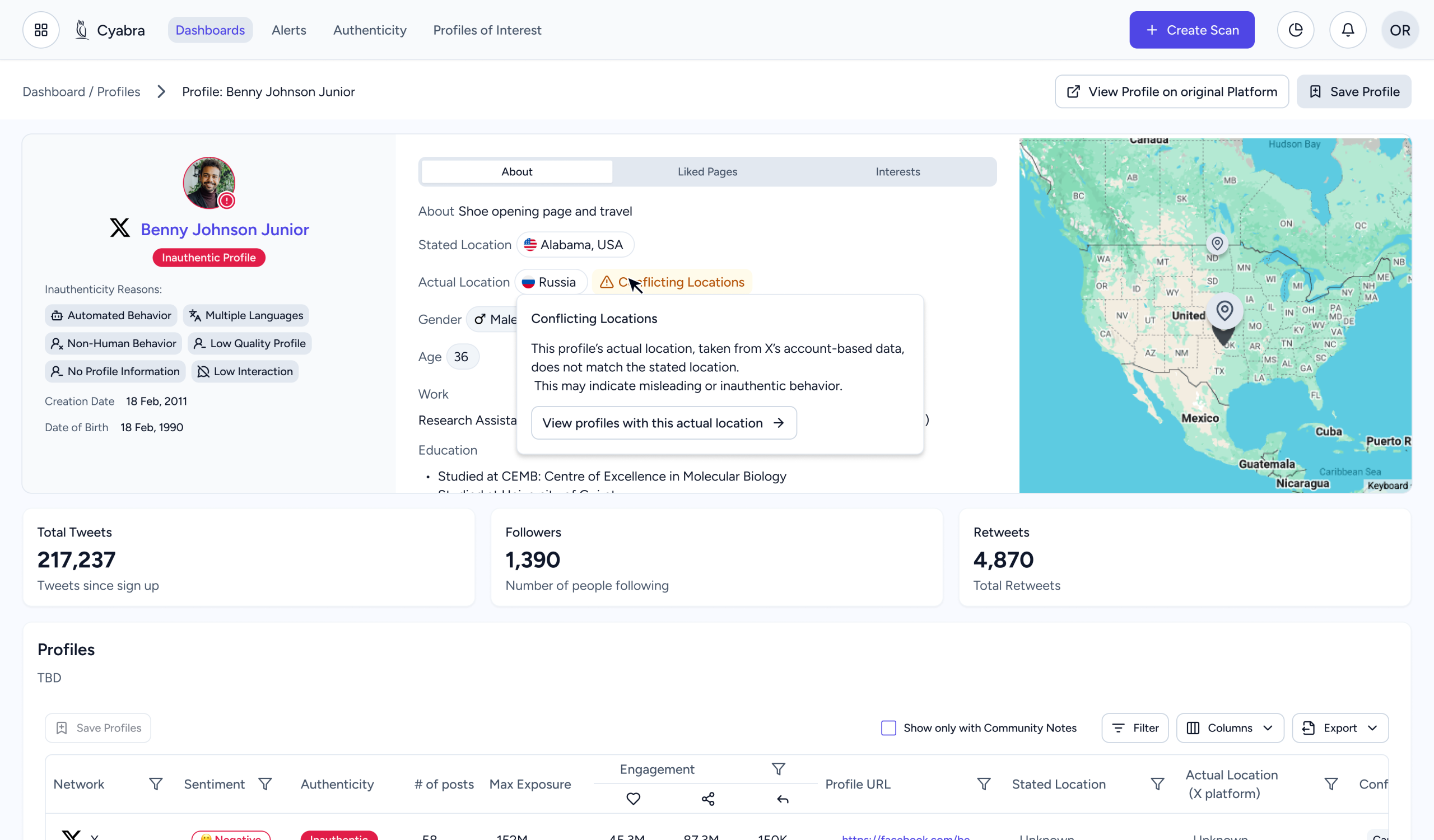
Cyabra is proud to announce the launch of a new Conflicting Locations feature, a groundbreaking tool designed to unmask the true origins of digital activity. This innovative capability directly addresses a critical vulnerability in online trust: the discrepancy between a profile’s stated location and its actual, data-verified geolocation.
The Problem with Fake Locations
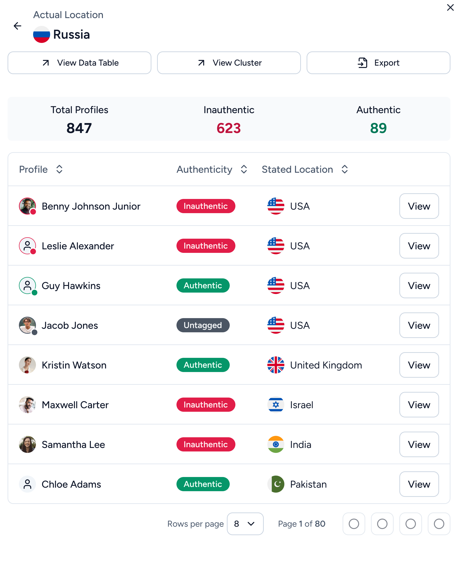
Imagine a social media profile claiming to be a concerned citizen in Alabama, USA, tirelessly posting about local issues. Now, imagine Cyabra’s AI reveals that the account’s actual point of origin is thousands of miles away, in Russia. This isn’t a hypothetical scenario: A recent Cyabra research into U.S. election discourse uncovered a striking pattern: 2,969 profiles were detected to have conflicting locations. The most dramatic example was 847 profiles that claimed to be in the USA but were actually operating from Russia. Of those, 623 were flagged as inauthentic.
These weren’t isolated incidents. Cyabra identified similar patterns across eight countries, including China, Nigeria, Saudi Arabia, Iran, Ghana, India, and Pakistan. Each cluster told the same story: accounts deliberately misrepresenting their true origins to build false credibility and manipulate conversations.
Why Conflicting Locations Matter
Cyabra’s new feature makes location deception visible at scale. Conflicting Locations compares the location stated by profiles against account-based geolocation data, instantly flagging discrepancies that may indicate coordinated activity, influence operations, or inauthentic behavior.
Catching individual bad actors is valuable, but seeing patterns changes everything. Cyabra’s platform allows you to:
- Analyze thousands of profiles simultaneously to identify geographic clusters of suspicious activity
- Map conflicting locations visually to understand where campaigns truly originate
- Drill down into specific countries to investigate profiles operating from each location
- Export data for deeper investigation and reporting
The Bigger Picture: Uncovering Influence Operations
Location-based deception is a cornerstone of modern influence operations. By claiming local identity, foreign actors gain credibility they haven’t earned and access to conversations they’re actively trying to manipulate.
Conflicting Locations removes the mask. This feature is part of Cyabra’s comprehensive solution, giving your team the intelligence they need to protect authentic discourse and make informed decisions by uncovering sophisticated, coordinated campaigns designed to sow discord and influence public opinion.
In an era where the lines between genuine discourse and fabricated narratives are increasingly blurred, understanding the “who” and “where” is paramount. For national security teams, brand managers, and public figures, identifying these hidden origins means the difference between being reactive and proactive. Cyabra’s Conflicting Locations feature is another powerful step towards building a more authentic and secure online environment.
Contact Cyabra to see our Conflicting Locations feature in action.