


Cyabra scanned the 2026 retail boycott conversation targeting Walmart, Starbucks, Home Depot, Amazon, and McDonald's, and found a coordinated inauthentic layer already sitting beneath the anger. Across Facebook, X, and Instagram, accounts moved between brands, clustered under the highest-reach posts, and rode hashtags real users had built, borrowing reach they hadn't earned. The boycott wave itself is real, a grassroots response to these retailers' diversity, labor, and political positions. What's not fully organic is some of the reach behind it.
- 12.6% of profiles engaging with the boycott conversation were inauthentic, a layer that spans every brand rather than concentrating on one target
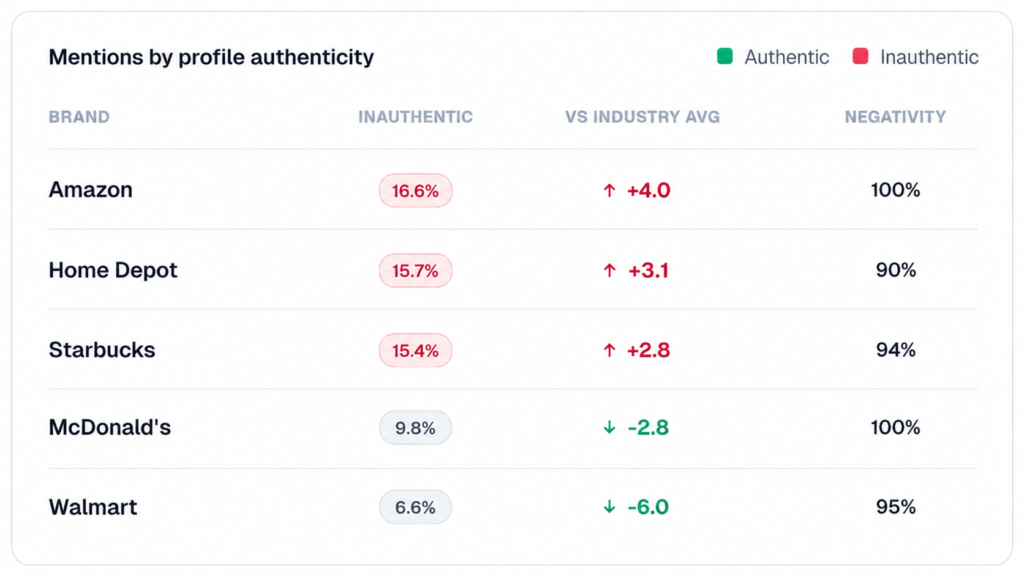
- Amazon, Home Depot, and Starbucks carried the highest inauthentic share of any brand in scope, roughly 2.4 times Walmart's rate
- Inauthentic accounts recur across brands, cluster beneath the highest-reach posts, and stuff generic hashtags to inflate their footprint
- On Instagram, the fake layer moved the needle: it earned a share of engagement disproportionate to its numbers
A Coordinated Layer Behind a Real Conversation
The boycott conversation itself is driven by real anger. But sitting beneath it is a consistent inauthentic presence, 12.6% of profiles. What stands out is not the size of that layer but its behavior. The same accounts move between Walmart, Starbucks, Home Depot, and Amazon rather than settling on a single brand, clustering in the replies under the loudest posts and reaching for generic hashtags to borrow visibility from conversations they didn’t start.
Why Amazon, Home Depot, and Starbucks Stand Out
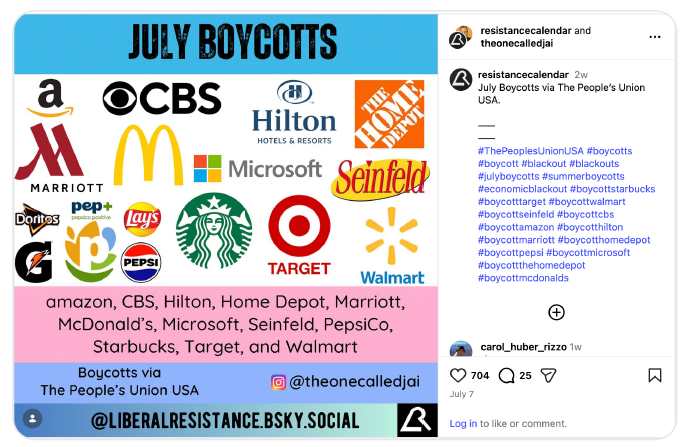
Not every brand in scope carries the same exposure. Walmart draws the most mentions overall, yet has the lowest inauthentic share, a sign that its volume reflects genuine public conversation. Amazon, Home Depot, and Starbucks tell a different story: each carries an inauthentic share roughly 2.4 times higher than Walmart’s, making them the boycott’s most manipulated targets even though the conversation around them is smaller.
Three Platforms, Three Different Exposures
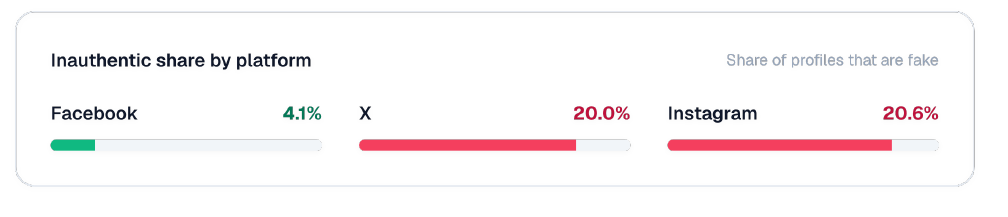
Facebook carried the most conversation and the least manipulation, with an inauthentic share of just 4.1%, concentrated on Walmart. X told a different story. One in five profiles was inauthentic there (20.0%), the highest share of any platform, clustering in replies beneath high-reach Starbucks and Home Depot posts, including the post that triggered the Starbucks boycott.
Instagram is where the fake layer did the most with the least. Its inauthentic share, 20.6%, was close to X’s, but the tone was different: mostly neutral, hashtag-driven content rather than direct attacks. That hashtag strategy paid off. Inauthentic accounts on Instagram pulled in 1,782 engagements, riding the same generic boycott hashtags real accounts were already using to reach real audiences.
What the Fake Layer Actually Buys
A recurring set of accounts that hops between five different brands, times its activity to land beneath the posts already drawing attention, and rides the same hashtags real users are searching, builds reach it didn’t earn organically. That is a lower-cost, more durable form of influence than manufacturing outrage from nothing: instead of creating a narrative, inauthentic accounts attach themselves to one already spreading and inflate its apparent size, quietly, brand by brand, platform by platform.
An Authentic Counter-Current Worth Noticing
Not every voice in this conversation is calling for a boycott. A smaller, largely authentic group of profiles said they would keep shopping at, or shop more at, the targeted brands, most surfacing on Facebook, the platform with the cleanest signal overall. This kind of support is easy to overlook entirely if a brand isn’t separating real voices from the fake layer sitting on top of the conversation. Once that layer is cleared away, it’s a group worth identifying and amplifying rather than competing against.
The Danger Is Already Active
A fake layer like this doesn’t need a crisis to move in. It only needs one to start using what it’s already built. It hasn’t originated the boycott narrative, but it’s already shaping how far that narrative travels: inauthentic accounts across all three platforms collectively pulled in well over 3,000 engagements without producing a single original narrative of their own, clustering under the exact posts driving the boycott and borrowing reach from conversations real users had already started. These accounts know which posts are spreading, which hashtags are trending, and which brands are exposed, and they move accordingly. Hopping between brands, timing their entry, exploiting hashtags built by real users, this is not accidental behavior, and it does not require a bigger network to do serious damage. It only takes the right moment, a leaked memo, a viral clip, a bad news cycle, for this same layer to stop padding a conversation and start driving one.
For brand and communications teams watching this space, a few things matter right now:
- Baseline your own exposure. Know your normal inauthentic share before a crisis hits, so a spike is visible immediately instead of getting lost in the noise of a real controversy.
- Watch where fakes cluster. Coordination shows up first in behavior, replies stacking under one post, the same hashtags recurring, before it shows up in raw volume.
- Don’t mistake organic anger for the whole story. Real sentiment and inauthentic amplification run side by side. Treating a boycott as purely organic, or purely manufactured, leads to the wrong response either way.
- Identify and support your authentic counter-voices. The customers already defending your brand are a more credible asset than anything a brand can manufacture on its own.
Download Cyabra’s full report on the retail boycott conversation
If your brand is watching a similar conversation unfold, get in touch with Cyabra to see what’s happening beneath the surface.
It spans every brand. Inauthentic accounts made up 12.6% of profiles in the conversation overall, and the same accounts moved between Walmart, Starbucks, Home Depot, and Amazon rather than settling on one target.
Walmart drew the most mentions but had the lowest inauthentic share, a sign its volume is largely genuine. Amazon, Home Depot, and Starbucks each carried an inauthentic share roughly 2.4 times higher than Walmart’s, despite smaller conversation volumes.
No:
* Facebook had the most conversation and the least manipulation, at 4.1% inauthentic
* X had the highest share, 20.0%, clustering in replies under high-reach Starbucks and Home Depot posts
* Instagram’s share (20.6%) was similar to X’s, but rode generic boycott hashtags instead of direct attacks, pulling in 1,782 engagements
* Baseline your normal inauthentic share so a spike is visible immediately
* Watch where fakes cluster, replies stacking under one post, before it shows up in raw volume
* Don’t treat the boycott as purely organic or purely manufactured, both readings lead to the wrong response
* Identify and support authentic customers already defending the brand