


Coordinated, AI-driven manipulation now shapes national security, markets, and reputations, often before anyone sees it happening. Knowing whether online activity is authentic, who is behind it, and how it spreads has become its own discipline. Gartner has now formally defined and assessed that market for the first time, naming Cyabra a Market Shaper in its inaugural 2026 Gartner® Emerging Market Quadrant for Narrative Intelligence — Startup Vendors. We believe our positioning reflects both the depth of what we’ve built and the urgency of the problem we’re solving.
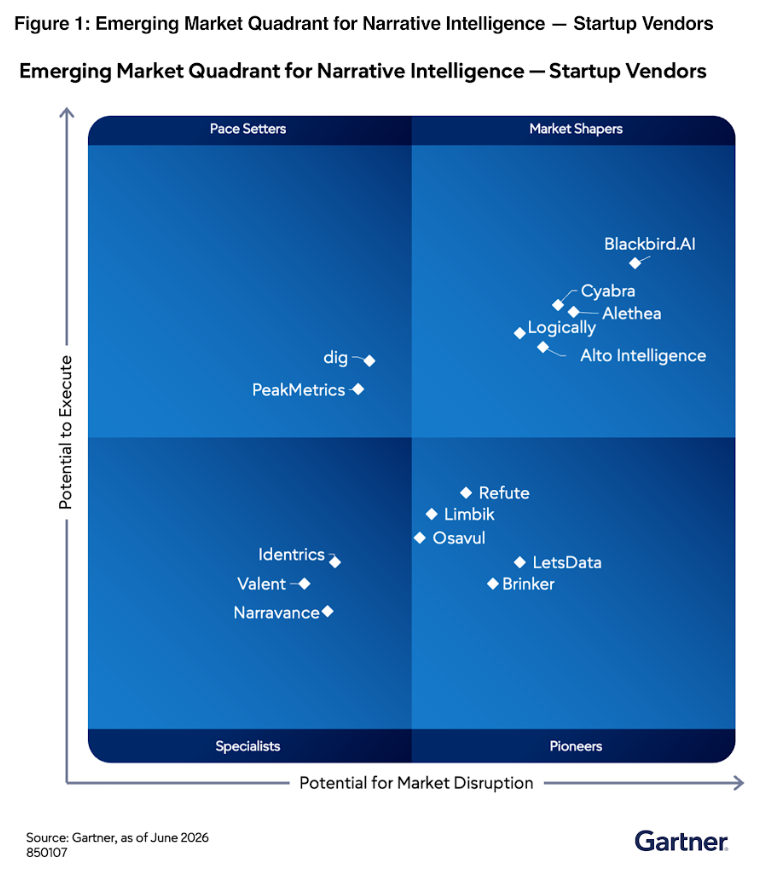
For the organizations we work with, this is bigger than a badge. To us, Gartner formally defining this category means that narrative intelligence has moved from an abstract concept to a concrete required discipline with a clear market, assessed vendors, and an established place in how enterprises and institutions think about information risk. That is a meaningful shift.
The problem the category addresses has been building for some time. Traditional social listening tools were built to measure what is being said, which is still a foundational requirement. They were not built to assess who is coordinating it, whether participation is authentic, or whether manufactured signals are distorting the picture organizations are acting on. The gap between those two questions is significant, and it has been widening as generative AI has made it faster and cheaper to create inauthentic accounts and synthetic content at scale. Narrative intelligence is not the replacement, but a critical evolution of this field.
Organizations that rely solely on content-level monitoring are increasingly making decisions based on a signal they cannot fully trust. That is the problem narrative intelligence is built to address. And that is why we built Cyabra. Our mission, restoring trust and authenticity for global enterprises and governments, has never been more relevant.
Why it matters: The World Economic Forum has identified disinformation as the most significant short-term global risk. At the same time, generative AI has accelerated the scale and sophistication of coordinated inauthentic activity, rendering content-level detection tools increasingly insufficient. Organizations need a layer of analysis that goes beyond what is being said.
How Cyabra Approaches the Problem
Cyabra is built around a single analytical framework connecting Actors, Behaviors, and Content. Rather than analyzing posts or keywords in isolation, it connects who is participating in a narrative, how they are coordinating, and what they are producing. This makes it possible to distinguish coordinated inauthentic activity from organic engagement at scale, and to measure whether that activity is materially influencing perception or remains contained.
The output is not a flag or an alert. It is structured, traceable evidence that communications, legal, and security teams can act on within their existing workflows. Cyabra does not make removal decisions or adjudicate truth. It provides the evidence organizations need to respond proportionately and with confidence.
A few deployments illustrate what that looks like in practice:
- U.S. State Department. When the State Department needed to assess the scope of foreign influence in conversations about China policy, Cyabra scanned more than 30,000 profiles across platforms. It found that 33% were inauthentic and that those accounts were generating 40% of the content in the conversation, allowing the team to separate foreign influence from authentic public discourse and assess the situation accurately.
- Warner Media. Ahead of a film release, Warner Media faced a coordinated negative campaign online. Cyabra analyzed nearly 280,000 profiles and identified a network of more than 25,000 inauthentic accounts responsible for approximately 40% of the negative content. Isolating that activity from genuine audience sentiment allowed the team to protect brand perception and redirect resources toward authentic communities.
Learn more about Cyabra’s work.
For Government and Public Sector Organizations
Information operations have become a primary instrument of geopolitical competition. Foreign actors use coordinated inauthentic activity to amplify division, erode institutional confidence, and shape the information environment ahead of elections, military events, and policy decisions. For government agencies, defense institutions, and public sector organizations, the challenge is not just detecting this activity but producing evidence that is traceable, defensible, and actionable within legal and policy frameworks.
Cyabra works with government agencies, defense research institutions, and intergovernmental organizations to map influence operations at the network level, identifying the actors behind coordinated campaigns, the behavioral patterns that connect them, and the narratives they are amplifying. The output is structured evidence that analysts and decision-makers can act on, not automated flags that require manual interpretation. For institutions operating in high-stakes information environments, the difference between signal and evidence matters significantly.
For Enterprise and Brand Organizations
For enterprises, the threat surface of coordinated inauthentic activity spans brand reputation, market integrity, and executive safety. Manufactured negative campaigns, stock price manipulation through coordinated narratives, and astroturfed pressure movements are increasingly difficult to distinguish from organic sentiment using standard monitoring tools. Organizations in media, financial services, consumer goods, and other reputation-sensitive sectors are finding that the tools built for social listening were not designed for this kind of threat.
Cyabra helps enterprise communications, security, and legal teams understand whether a reputational threat is organic or coordinated, how large the inauthentic component is, and where it is originating. This allows teams to respond proportionately: investing resources in authentic communities rather than reacting to manufactured pressure, and building the evidentiary record needed to escalate to platforms or legal counsel when appropriate.
What We Have Built
Over the past two years, we introduced capabilities that reflect how the problem has evolved:
* Coordination Network Detection identifies structural behavioral patterns across platforms, including synchronized posting and shared amplification pathways, moving analysis from identifying who is speaking to understanding how activity is organized.
* Synthetic Media and Impersonation Detection identifies synthetic accounts and impersonation attempts within their broader network context, rather than as isolated artifacts. This makes it possible to detect not just individual synthetic elements, but how they are deployed as part of coordinated activity.
* Cross-Platform Narrative Tracking follows how narratives originate, evolve, and propagate across platforms and media ecosystems, linking claims to the actors and networks driving them.
* Evidence-Based Mitigation Workflows generate structured evidence packages aligned with platform policies and legal frameworks, allowing communications, legal, and security teams to take proportionate action within their existing processes.
* Dynamic Profiling creates a continuous feedback loop where identity-level signals refine system-wide analysis in real time, improving accuracy and reducing reliance on manual query adjustments.
Dive deeper into Cyabra’s solution
What Comes Next
Our takeaway from Gartner publishing a report on this category is that the market has reached a level of maturity where organizations are actively seeking solutions, not just awareness of the problem. We see this in our own pipeline and in the conversations we are having across enterprise, government, and public-sector organizations globally.
The problem is not going to get simpler. Generative AI will continue to lower the barrier for coordinated inauthentic activity. The organizations best positioned to navigate that environment will be the ones that have analytical infrastructure in place before the next campaign, not after it.
That is why we built Cyabra, restoring trust and authenticity for global enterprises and governments. And it is why we will keep building it.
Access the Full Gartner Report
You can download a complimentary copy of the 2026 Gartner® Emerging Market Quadrant for Narrative Intelligence — Startup Vendors through our resource page. The Gartner report provides full assessment of the market, the vendors evaluated, and the dynamics shaping how organizations approach narrative risk.
Download the complimentary Gartner report
GARTNER DISCLAIMER
Gartner is a trademark of Gartner, Inc. and/or its affiliates. This graphic was published by Gartner, Inc. as part of a larger research document and should be evaluated in the context of the entire document. The Gartner document is available upon request from Cyabra.
Gartner does not endorse any vendor, product or service depicted in its research publications, and does not advise technology users to select only those vendors with the highest ratings or other designation. Gartner publications consist of the opinions of Gartner’s business and technology insights organization and should not be construed as statements of fact. Gartner disclaims all warranties, expressed or implied, with respect to this research, including any warranties of merchantability or fitness for a particular purpose.
* Gartner, Emerging Market Quadrant for Narrative Intelligence, By Alfredo Ramirez IV, Apeksha Kaushik, Akif Khan, Amber Boyes, David Senf, 26 June 2026