


Real shoppers drove the backlash against Target, Amazon and Walmart heading into Black Friday. But Cyabra's research found that inauthentic accounts added a reply layer on top of it, concentrated under the retailers' own posts and growing sharply as deal week approached.
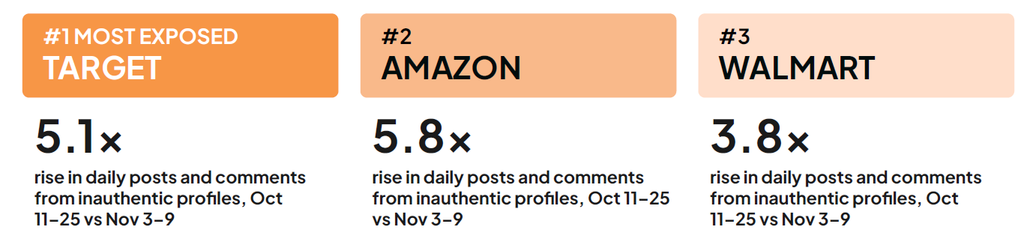
- Daily posts and comments from inauthentic accounts rose 3.8 to 5.8 times between mid-October and deal week.
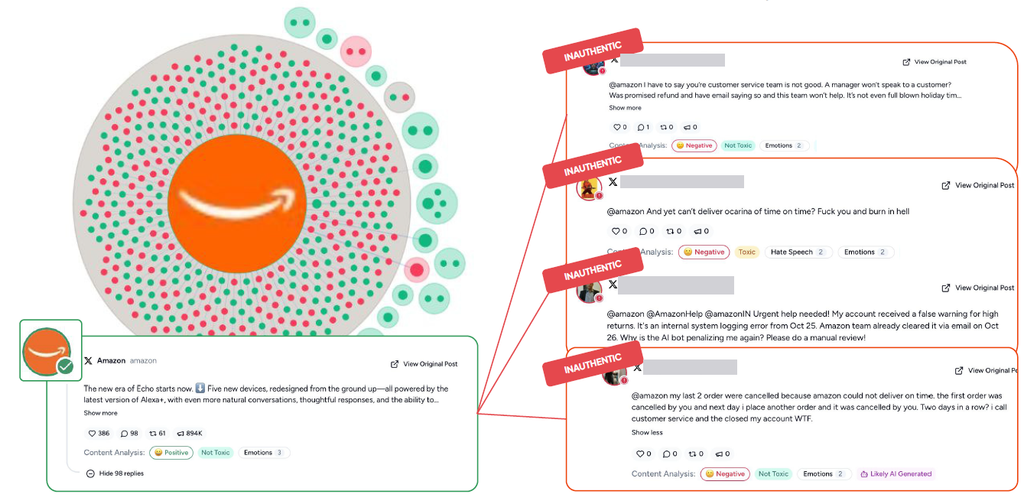
- On X, 47.2% of the profiles replying to Amazon's official posts were inauthentic.
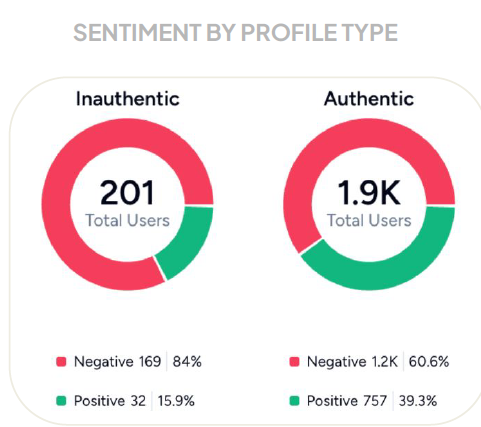
- 74% of inauthentic content was negative, compared with 59% from authentic profiles.
- Inauthentic profiles wrote 22.5% of Amazon's delivery and refund complaints, and about three in four of them posted directly under Amazon's official posts.
Real shoppers started each backlash
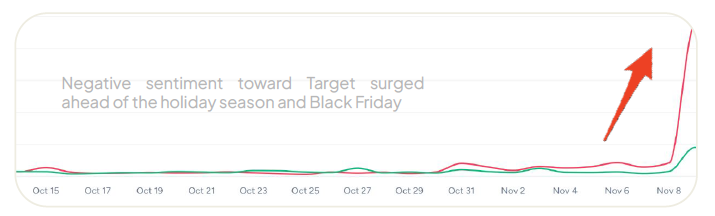
Each retailer faced its own leading narrative. At Target, a Facebook video criticizing its holiday displays drew 2.2 million views and replies from people describing themselves as former regular shoppers. The DEI-related boycott behind it drove more than four in five negative posts and comments about Target, and from late October it made up more than half of Target’s conversation.
Amazon faced complaints about packages marked delivered that never arrived, refunds that were denied or reversed, used devices sold as new and locked accounts with no one to help. Walmart drew allegations of price manipulation, from underweighted meat to digital shelf tags, alongside delivery complaints and safety controversies. Elected officials added visibility to the pricing complaints, and a quarter of Walmart’s negative content included calls to boycott the retailer.
Across all three retailers, authentic profiles carried the conversation. Their content drew 98% of the views, and on Facebook, almost every profile discussing Target was authentic, sharing personal experiences.
Inauthentic accounts worked in the replies
Inauthentic accounts behaved differently. 87.4% of their content was replies or comments, and 62% of it appeared on X. They earned only 1.5% of the engagement, so their influence showed up in tone. At every retailer, their content was more negative than that of authentic profiles, 80% compared with 69% at Amazon and 76% compared with 60% at Walmart. The result was a conversation pushed further toward criticism than real shoppers took it on their own.
They also helped narratives travel. At Target, inauthentic profiles made up 6.5% of the boycott conversation, mostly as comments on TikTok and X, carrying a backlash that began on Facebook to new audiences.
Replies were also where readers looked to judge the story. On a viral X clip of an officer confronting a Target shopper, five of the eight captured replies came from inauthentic profiles.
Amazon’s own posts became the stage
Amazon’s narrative saw the strongest inauthentic amplification of the three. Inauthentic profiles wrote 22.5% of the delivery and refund complaints, the highest share of any retailer, and about three in four of them posted directly under Amazon’s official posts, some repeating the same complaint. Across Amazon’s official posts on X, 47.2% of replying profiles were inauthentic.
The effect was that Amazon’s own holiday announcements arrived surrounded by delivery and refund complaints, exactly where customers and journalists looked first. The timing raised the stakes: the conversation more than doubled in November as Amazon’s early Black Friday sales began.
Inauthentic activity climbed into deal week
Comparing October 11 to 25 with November 3 to 9, daily posts and comments from inauthentic accounts rose 5.8 times at Amazon, 5.1 times at Target and 3.8 times at Walmart.
Walmart showed how that rise could outlast real interest. Authentic activity in its negative narratives peaked on November 2, yet the inauthentic share kept climbing, from 7.6% to 13.2% in deal week. That kept alleged pricing and service problems visible while Walmart promoted its Black Friday prices. At Target, the boycott conversation grew elevenfold in the second half of the period and peaked less than three weeks before Black Friday. Across the three retailers, boycott calls spanned shopping categories, from electronics and clothing to groceries for holiday meals.
What this means for brand and communications teams
- Separate the grievance from the amplification. Real shoppers drove each narrative, so responses needed to address their concerns directly, with a clear view of how much of the reply volume was inauthentic.
- Watch your own channels first. Official posts and announcements were where inauthentic replies concentrated, especially at Amazon.
- Track the inauthentic share over time as well as volume. At Walmart, it rose after real interest faded, a shift a mention count would have missed.
- Set baselines before peak moments. Inauthentic activity climbed 3.8 to 5.8 times ahead of deal week, so monitoring and response plans need to be in place before launches and sales events.
Download the full research to see each retailer’s leading narratives, sentiment trends and examples of inauthentic amplification.
To understand who is driving the conversation around your brand ahead of peak season, contact Cyabra.