


That singer you’ve never heard of, showing up on your feed for the third time today, might not be catching on. He might be getting bought there. A new industry has formed around manufacturing the exact feeling of a trend before it exists: fund a clip, hand it to hundreds of creators, and let the algorithm mistake early paid traction for real demand. Cyabra’s CPO Yossef Daar spent years running campaigns like this before he spent years building the systems that expose them, and in this piece he breaks down exactly how “everyone is talking about it” gets sold, and what’s worth checking before you believe it.
You open TikTok, Instagram Reels, YouTube Shorts, or X, and you see a clip of a singer you have never heard of. Ten minutes later the same singer surfaces again, this time from a different account. Then a slice of an interview. By the evening someone has posted a video explaining why “everyone is talking about him.” The next morning a news outlet runs a piece on the new phenomenon.
From where you sit, something simple happened: a thing became popular.
Behind the scenes, something entirely different may have happened. Someone opened a campaign, set a budget, offered a payout for every thousand views, and handed raw footage to a few hundred people. Each of them cut their own version, posted it to their own account, and tried to make it land.
I have spent the last eight years at Cyabra on the defensive side of this problem, building systems that detect coordinated inauthentic behavior and fabricated narratives across social networks and news ecosystems. For three and a half years before that, I was on the other side, running the kind of campaigns I now work to expose. That vantage point taught me one uncomfortable lesson early: the invisible hand that shapes what looks like public consensus is rarely as invisible as it wants to be, and it is almost never as organic as it looks.
What has changed is that the invisible hand no longer needs a state, a troll farm, or a basement full of bots. It needs a credit card.
The market where virality is sold by the view
Over the past few years an entire industry has formed around what is now openly called the clipping economy. Public radio’s reporting on the trend describes short-form video clippers effectively overrunning the internet, taking a single long asset, a podcast, an interview, a livestream, and slicing it into dozens of short cuts that get scattered across every platform (WMRA/NPR).
When a creator clips their own work, there is nothing new about it. The shift is that clipping became a business model. On platforms like Whop, a brand can open a campaign, upload the source material, set a budget, and pay participants according to the number of views each of them generates (Whop Content Rewards documentation). Instead of producing five videos and hoping one performs, you now have hundreds of people trying at once.
One adds a dramatic headline. One cuts the clip a beat before the most intriguing sentence. One frames it as breaking news. One posts through an account that reads like a fan page or an entertainment feed. Most of these attempts fail, and it does not matter. If ten out of several hundred start accumulating views and two of them detonate, the campaign worked.
This is a controlled experiment run at enormous scale. Try everything, measure what sticks, and pay mainly for what succeeded. For an advertiser it is a beautiful model, because the risk of failure is pushed downstream onto the distributors.
The reframe from “watch this” to “everyone is already watching this”
A conventional ad is usually labeled as an ad. A clip arriving from an account that looks like an ordinary user, a fan page, or an entertainment channel reads very differently. The viewer has no particular reason to know that someone paid for that clip to travel.
And that is the entire advantage. Instead of telling you “you should see this,” the invisible hand tries to make you believe “everyone is already seeing this.” Marketing firms in this space have started building around an idea worth naming plainly: trend engineering. Take a phenomenon that succeeded on its own, study exactly how it spread, which formats appeared, at what cadence, to which audiences, in what volume, and then reproduce that same signature for a product, an artist, or a message. The question stops being “how do we get people to talk about this?” and becomes “what does the internet look like once everyone is already talking about it, and how do we manufacture that appearance in advance?”
Then the algorithm takes over
Here is the part that matters most, and the part most executives miss.
Say a few hundred accounts upload variations of the same clip. Most interest no one. A handful start collecting views. People stop on them, share them, comment, watch to the end. The recommendation system reads that behavior and begins pushing those clips to a larger audience.
At that point, people who were never paid a cent enter the picture. They share the clip, react to it, look up the person in it, and talk about it with friends. Something that began as a funded push becomes an authentically organic phenomenon. Culture writers have documented exactly this blurring, where coordinated clipping and genuine fan enthusiasm become impossible to separate after the fact (Vulture).
This is why the line between “fake” and “real” has dissolved. The ignition can be artificial while everything after it is completely genuine.
Behavioral research established long ago that we are powerfully influenced by what appears popular to others. When people see that a song, a clip, or an opinion is already receiving attention, that perceived popularity alone pulls in more attention, and small early advantages can snowball into large and largely unpredictable outcomes (academic research on social influence and online popularity, PMC). The algorithm amplifies the loop: we respond to what it shows us, and it learns from the response and shows us more of the same.
So a campaign never has to persuade a million people. It only has to persuade the recommendation system that a million people are worth showing it to.
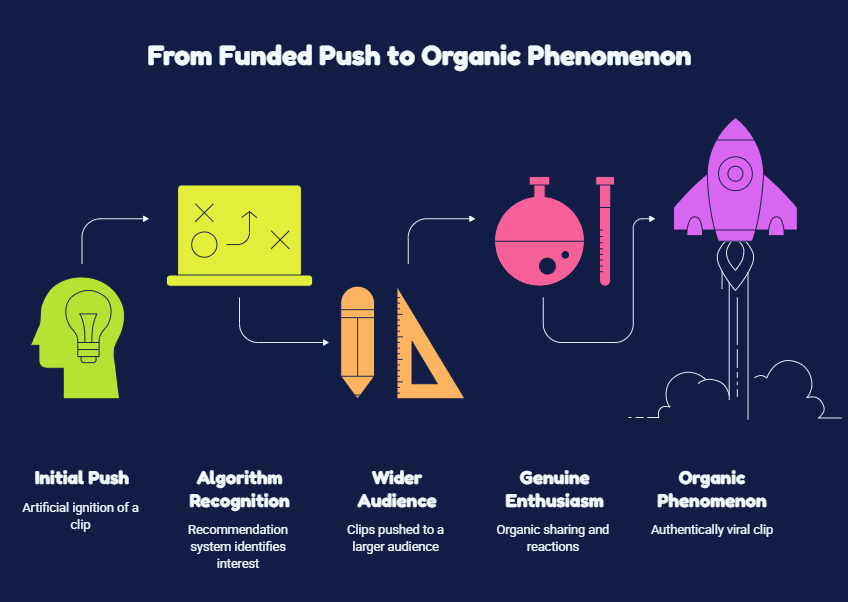
How the sensation of “everyone is talking about it” is built
From here a cycle forms that is very hard to see from the inside. A journalist opens TikTok and keeps seeing the same subject. A creator sees it and decides to make a video about it. A news desk notices a lively online conversation and publishes a piece. The piece itself gets shared and becomes one more signal that this is an important topic.
At some point it is genuinely impossible to say what came first. Did the public get interested and so the thing became popular, or was it shown to the public over and over until the public became interested?
The old world at least had shared yardsticks: sales, ratings, radio spins, box office. Those could be gamed too, of course. But in the algorithmic feed we do not share a picture at all. Each of us gets a different feed. If you see something ten times a day, you have no way to know whether the rest of the country is also seeing it ten times, or whether the system simply decided you were the right audience for it. The very feeling that “this is everywhere” has stopped being good evidence that anything is actually everywhere.
Not just selling a product, shaping the conversation
If you can manufacture the sense that something is popular, you can also try to shape how people talk about it. Not only “watch this film,” but “everyone thinks this film is brilliant,” “everyone is furious about this,” or “there is a huge storm right now around this issue.”
Firms that track coordinated activity, my own included, have repeatedly identified cases where inauthentic accounts or organized activity amplified arguments that already existed. That distinction is important. You do not always have to invent a controversy. Often it is enough to take a small, real disagreement and inflate it until it looks like a public firestorm. From there, real people carry it forward on their own.
When the same playbook reaches politics
The technology that markets a product markets an idea just as easily. In recent years the U.S. Department of Justice has disclosed influence operations that used several tools in parallel: social media accounts, websites dressed up to look like established news outlets, paid promotion, influencers, and AI-generated content (U.S. Department of Justice).
The goal there is not to sell shoes or a song, it is to move public perception. But the method is the same: produce a great deal of content, distribute it through sources that look unrelated to one another, hit the same audience again and again, and hope real people pick up the distribution themselves. The boundary between marketing, public relations, and an influence operation is not always found in the tools. Sometimes the only difference is who is paying and what they are trying to achieve.
Why the economics are so attractive
The internet already built, for the influence industry, the one thing that used to be expensive: a global distribution system. An advertiser once had to buy airtime, a newspaper page, a billboard, or ad space in advance. In the new model the risk moves to the distributors. A hundred people make videos, ninety go nowhere, ten succeed, and the advertiser pays mainly for the success.
That efficiency has a price. When payment is tied to views, the distributor is not rewarded for accuracy or balance. They are rewarded for making you stop scrolling. An inflammatory headline outperforms a measured one, a sentence pulled out of context outperforms the full explanation, and a fight draws more views than an agreement. The clipping economy is not necessarily built on lies. But it very reliably rewards whatever grabs attention, by almost any means.
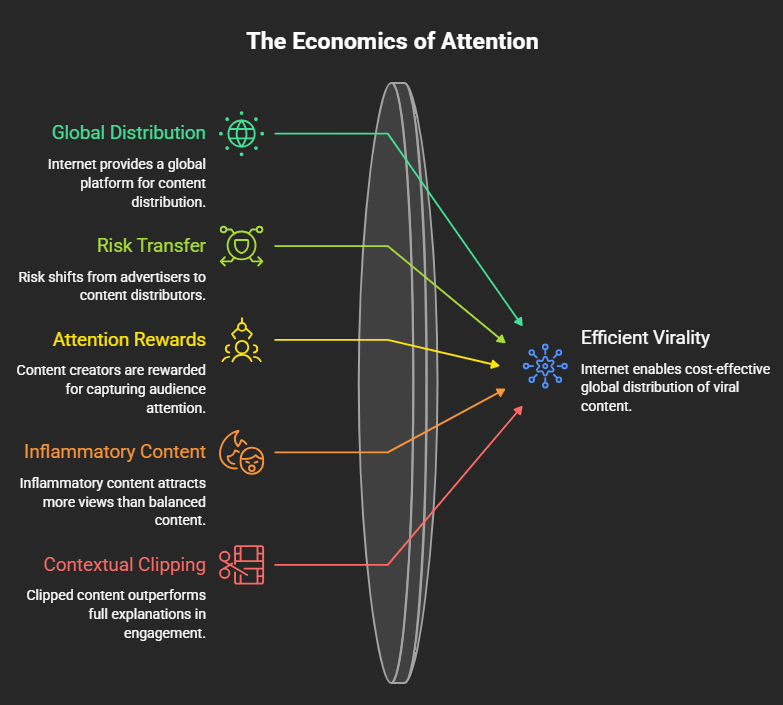
What the law actually says
In the United States, the Federal Trade Commission requires a clear disclosure in certain cases when a person receives money, a product, or any other consideration for promoting a good or service (FTC guidance on endorsements, influencers, and reviews). The fact that someone is not a famous influencer but a small account posting clips does not automatically exempt them from that obligation.
There are also rules against buying fake influence metrics, followers or views generated by bots and fabricated accounts. It is worth keeping the categories separate. Hundreds of real people paid to distribute a clip are not, in themselves, fake views. But if the viewer does not know they were paid to distribute it, a different question arises, the question of undisclosed advertising. TikTok and YouTube likewise require commercial content and sponsorships to be labeled in certain cases. Enforcement simply gets far harder when a single influencer is replaced by hundreds of small accounts and subcontractors.
The platforms are starting to push back
TikTok, Meta, and YouTube have their own problem here. On one hand, short content is exactly what keeps people in the feed. On the other, if a user keeps seeing twenty near-identical versions of the same clip, the quality of the platform itself degrades. Meta has already begun giving greater priority to original content and reducing the reach of accounts that recycle other people’s material, and other platforms are gradually tightening the rules around commercial content and repeated uploads.
But this is a cat-and-mouse game. If an identical clip gets less reach, you re-edit it. If a watermark is a problem, you strip it. If copied content is penalized, you bolt on a few sentences of commentary. The clipping industry does not need to understand exactly how the algorithm works. It only needs to try enough variations to discover what works today.
The next front: influencing the AI itself
The story does not end on social networks. As more people use AI systems to get recommendations, search for products, compare services, and learn about new topics, a new target opens up. Instead of persuading a person directly, you can try to influence the information the AI system encounters on its way to an answer. A field has grown up around making brands, products, and sites appear more often in the answers of AI engines, a new version of search engine optimization.
There is nothing inherently wrong with that. But research in 2026 has already shown that misleading content, or content deliberately planted across the web, can influence AI-based search and research systems. The implication is simple. Today you can produce hundreds of videos to make an algorithm think a brand is popular. Tomorrow you will be able to produce hundreds of reviews, pages, and posts to make an AI system think it is recommended. And the user may never see the campaign at all. They will only see the answer.
This is the frontier we are building toward at Cyabra, because the invisible hand is already reaching past the human feed and toward the models that increasingly sit between people and reality.
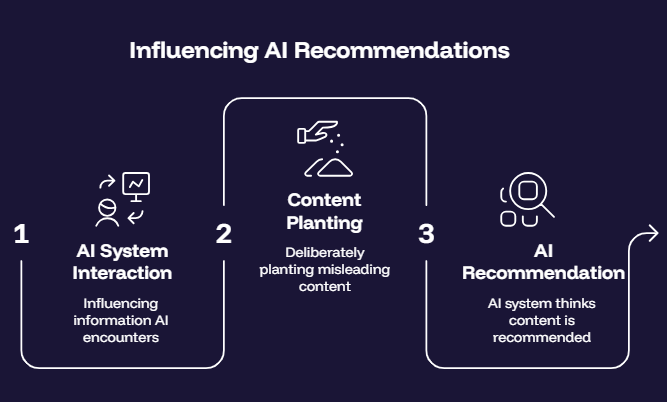
So is the feed completely fake?
No. Not completely. The world is not made entirely of bots, PR firms, and secret campaigns. Real hits exist. Real storms exist. People genuinely love things and share them with others.
But the ability to buy the starting point changes how you have to read the feed. When something suddenly appears everywhere, the questions worth asking are:
- Who started distributing it?
- Did someone pay for the distribution?
- Did a lot of accounts begin posting it at the same time?
- Is it clearly advertising?
- Did it become popular because the public chose it, or because someone managed to make it look popular first?
For years we trained ourselves to recognize advertising. Now we have to learn to recognize something far less obvious: advertising disguised as popularity. The invisible hand is counting on the fact that most of us never learned the difference.
______________________________
Yossef Daar is Chief Product Officer at Cyabra, where he leads the development of systems that detect and analyze coordinated inauthentic behavior and fabricated narratives across social networks and news ecosystems. His experience on both sides of influence operations provides a unique vantage point on how manufactured consensus shapes markets, politics, and public reality.
Read More:
- The clipping economy, how short-form video clippers are overrunning the internet, WMRA/NPR
- Content Rewards, Whop documentation
- Endorsements, influencers, and reviews, U.S. Federal Trade Commission
- Justice Department disrupts covert Russian government-sponsored foreign malign influence, U.S. Department of Justice
- Academic research on social influence and online popularity, PMC
- Social media feeds and the chaotic-good world of clipping, Vulture
* Platforms like Whop let a brand fund one clip and pay hundreds of creators based on the views each one generates.
* Content moves through accounts that look like fan pages or ordinary users, not labeled brand or agency profiles.
* Once enough accounts post variations of the same clip, the recommendation system reads the engagement as genuine interest and starts amplifying it further.
* Reframed pitch: Replaces “watch this” with “everyone is already watching this,” leaning on how perceived popularity drives more attention on its own.
* Cheap experimentation at scale: Hundreds of accounts test different headlines and cut points on the same footage, and the campaign only pays for what lands.
* Disclosure gap: FTC labeling rules exist, but enforcement is far harder when one sponsored influencer becomes hundreds of small, easily overlooked accounts.
The same mechanics built to sell a clip or a song translate directly to shaping political narratives. The U.S. Department of Justice has disclosed influence operations that combine coordinated accounts, fake news-style websites, paid promotion, and AI-generated content, the same building blocks used to move a product. Operators often don’t even need to invent a controversy; inflating a small, real disagreement until it looks like a public firestorm is usually enough for real people to carry it forward on their own.
* The same source footage, re-cut into different formats, suddenly appears across many unrelated accounts within a short window.
* A large share of the views comes from accounts styled as fan pages or entertainment feeds rather than established creators.
* There’s no sponsorship label anywhere in the chain, even though the pattern points to a funded campaign.