


Over the course of a full year, Cyabra tracked how coordinated inauthentic activity moves through stock market conversations, following ten tickers across 2024 and 2025 to see not just how much fake activity exists, but how much its impact has changed over time. The result is one of the most detailed pictures yet of how fake profiles operate inside financial discourse, from slow-building smear campaigns to fast-moving promotional pushes, and what that means for anyone trying to read the market's true sentiment.
- Fake stock manipulation discourse grew 4 percentage points between 2024 and 2025, accompanied by a 50.8% surge in engagement, a material escalation in both volume and influence
- Fake profiles aren't spread evenly across the market. They operate in targeted campaigns, systematically amplifying or suppressing specific stocks to shape investor perception
- Fake profiles' coordination is highly effective: identical or near-identical messages posted within the same minutes drive high-volume, synchronized amplification
- Manipulation tactics are advancing: fake accounts increasingly adopt seemingly credible investor identities, leveraging perceived expertise rather than raw volume to influence market sentiment
Cyabra’s Investigative Method – And What We’ve Uncovered
Cyabra’s detection technology analyzes social media activity using over 500 behavioral and contextual parameters, including posting frequency, language patterns, network behavior, and engagement, achieving a detection accuracy rate above 90% in distinguishing authentic users from fake or manipulated profiles. For this investigation, Cyabra applied that technology to social media conversations across ten stock tickers on X throughout 2024 and 2025, tracking how coordinated inauthentic activity is reshaping financial discourse. The goal wasn’t just to count fake profiles, but to understand how their tactics are evolving.
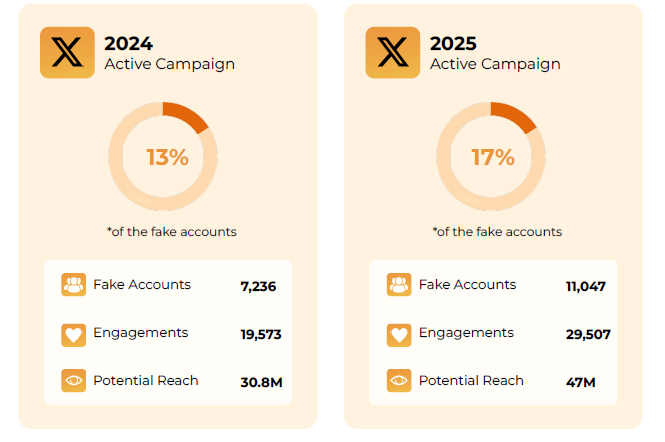
The scale of the shift is clear. Fake accounts made up 13% of stock-related conversation in 2024. In 2025, that share grew to 17%, a 4 percentage point increase. The impact grew even faster: engagement from fake profiles surged 50.8% year over year, and potential reach expanded 52.6%, for a combined 77.8 million views across the accounts analyzed. Fake profiles have not only grown in numbers – they have gotten better at being heard.
Coordinated Campaigns Have Replaced Random Noise
The most important shift isn’t the overall growth rate. It’s what that growth is made of. Fake profiles aren’t spread evenly across market conversations. They operate in targeted, sustained campaigns aimed at specific stocks, either amplifying them or working to discredit them, and the two ends of that spectrum look almost nothing alike.
On the discrediting side, a single account created in May 2025 shows how far one coordinated operation can go. It posted more than 18 times a day on average, generating over 17,400 posts in total, with roughly 80% of that content built around one goal: framing Tesla ($TSLA) as an unattractive investment. The narrative followed five consistent threads: claims of declining sales in markets like Europe and China, skepticism dismissing Tesla’s robotaxi and autonomous driving plans as unrealistic, assertions that the company hasn’t meaningfully innovated since the Model Y, comparisons framing its technology as outdated next to competitors, and personal attacks on Elon Musk’s leadership. Every post embedded the $TSLA ticker directly, a tactic that plants the narrative inside active investor conversations rather than general brand commentary.

An analysis of a single fake account massively active in attacking Tesla.
On the amplifying side, fake accounts promoting Berkshire Hathaway ($BRK.B) nearly doubled year over year, growing from 598 accounts in 2024 (21% of the conversation) to 1,188 in 2025 (35%), a 98% increase in account volume and a 14 percentage point jump in share of conversation. Across 2025, that network generated roughly 2,000 engagements and nearly 400,000 views, with 40% of engagement and 42% of views concentrated in just the final quarter of the year, a spike that coincided with heightened attention around CEO Warren Buffett’s step-down.
Same underlying mechanism, opposite direction: manufacture doubt where a network wants a stock to fall, manufacture confidence where it wants a stock to rise.
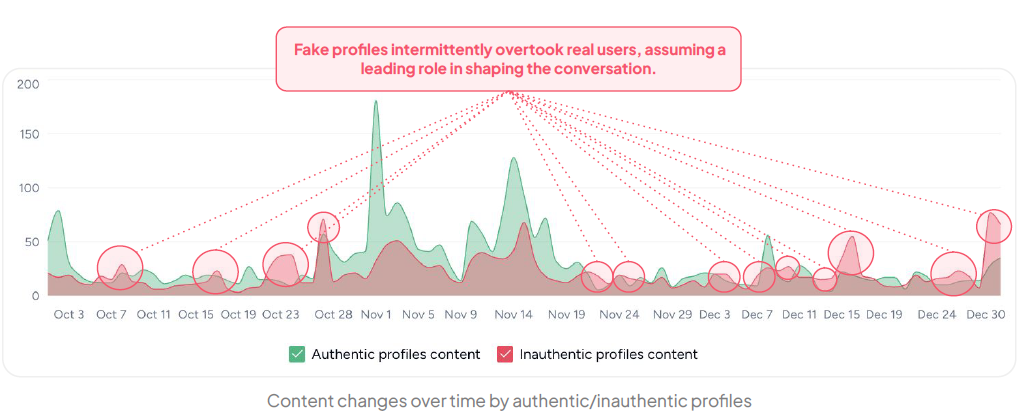
Fake profiles surpassing organic activity in BRK.B discourse
Fake Profiles Look More Organic Than Ever as They Move Together
Underneath both campaigns, the coordination signals are consistent. Profiles post identical or near-identical messages within minutes of each other, often with only minor variations in punctuation or phrasing. Account creation clusters tightly within narrow windows, with a large share of the Berkshire Hathaway network created between August 2024 and early 2025. And in that same case, fake profiles at points outproduced authentic users entirely in overall content volume during the final quarter of 2025, an outcome that remains rare even among coordinated manipulation efforts.
What’s changing is how that coordination gets dressed up. Rather than relying on obvious spam, coordinated networks are increasingly building personas designed to look like genuine expertise. Some profiles present themselves as individual traders and investors, using finance-forward usernames and confident, signal-oriented language to imply personal insider knowledge. Others are built to resemble dedicated trading and alerts pages, branding themselves as sources of market insight. Both archetypes work toward the same end: making coordinated promotion read as independent, credible advice. Layered on top is deliberate language design, market jargon like “price target” and “new alert” borrowed to project expertise with no actual analysis behind it, paired with urgency-driven phrasing built to accelerate impulsive investment decisions.
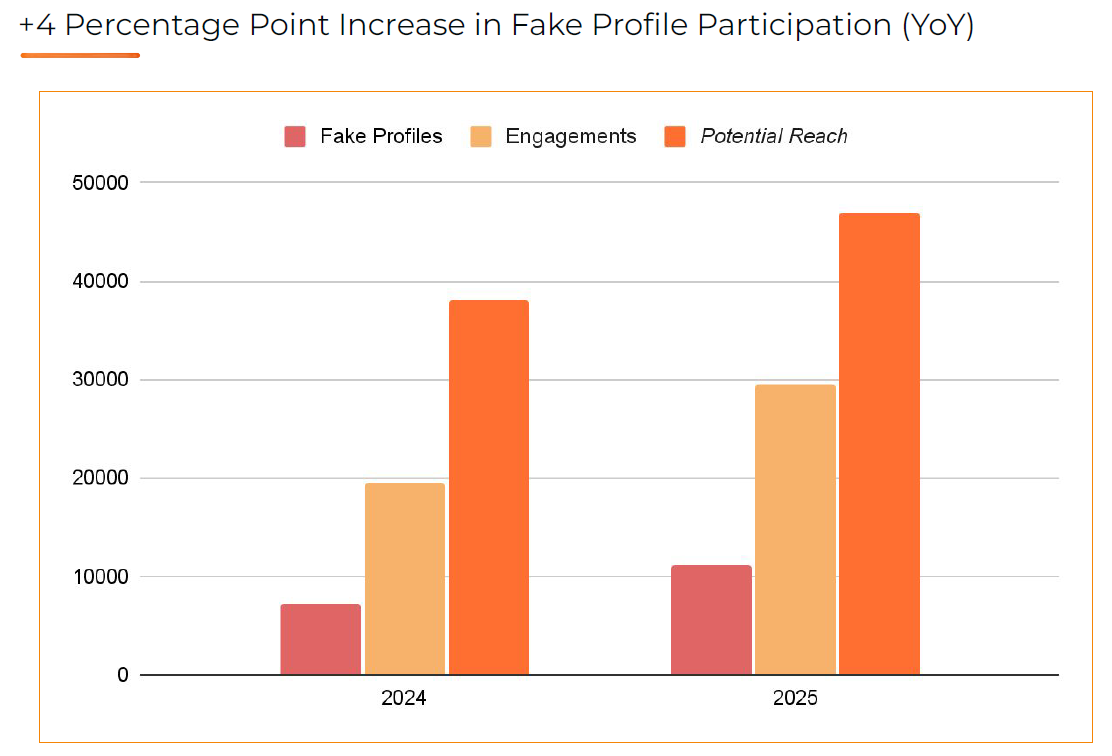
Fake profiles increase in numbers, engagement, and potential reach
What This Means for Public Companies and Investors
The throughline across this year’s data is a shift from volume to trust. Fake profiles used to rely on flooding a conversation. Now they’re built to be believed. For IR and communications teams, that means monitoring has to change too:
- Track ticker-specific spikes separately from brand mentions. A sudden jump in volume around your stock symbol specifically is the earlier and more reliable signal.
- Watch bullish spikes as closely as bearish ones. The same coordinated tactics that manufacture doubt to push a stock down can manufacture confidence to pump one up. A wave of unusually confident, urgent buy signals deserves the same scrutiny as a pile-on of criticism.
- Check coordination before trusting credibility. Accounts that sound like investors or trading experts should be verified against coordination patterns, identical phrasing, synchronized posting times, clustered account creation, before being read as genuine market sentiment.
- Have a response plan before the spike hits. Know in advance who verifies suspected inauthentic activity, who drafts a statement if needed, and how fast that process can move. Crisis response built after the fact is already too slow.
Download the full report by Cyabra
Fake accounts made up 13% of stock-related conversation in 2024, growing to 17% in 2025, a 4 percentage point rise. The impact outpaced that growth: engagement from fake profiles surged 50.8% year over year and potential reach expanded 52.6%, for a combined 77.8 million views. Fake profiles didn’t just grow in number, they got better at being heard.
No, the same mechanism runs in both directions. On Tesla, a single account created in May 2025 posted more than 18 times a day, over 17,400 posts total, roughly 80% built around framing $TSLA as an unattractive investment. On Berkshire Hathaway, the opposite happened: fake accounts promoting $BRK.B nearly doubled, from 598 accounts (21% of the conversation) in 2024 to 1,188 (35%) in 2025, with 40% of engagement concentrated in the final quarter, coinciding with Warren Buffett’s step-down.
The coordination itself hasn’t changed much, identical messages posted minutes apart, account creation clustered in tight windows. What’s changed is the disguise. Rather than obvious spam, networks now build personas that look like real traders or dedicated alerts pages, using finance jargon like “price target” and “new alert” to project expertise with no actual analysis behind it.
* Track ticker-specific spikes separately from general brand mentions, they’re an earlier signal
* Watch bullish spikes as closely as bearish ones, since the same tactics work in either direction
* Verify accounts that sound like investors against coordination patterns before treating them as genuine sentiment
* Have a response plan ready before a spike hits, not after